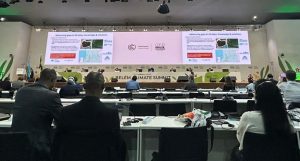

Photo credit: Group on Earth Observation (GEO) from their update session at COP30
Donna Lyndsay and Andrew Coote offers insights for 2026 and beyond
Commercial Sector Leadership at COP30
The outcome of COP30 has left many observers concerned, with the perception that the conference achieved little new to address the consequences of climate change. As a result, anxieties regarding an increasingly warmer world and its associated challenges have been exacerbated.
Nevertheless, while political leaders may have retreated from earlier commitments, the corporate sector is quietly assuming a more prominent leadership role. Commercial entities seeking to remain resilient and profitable beyond 2030 are proactively enhancing their adaptive capacities. These companies are not doing this altruistically; they recognise the potential to improve competitiveness, reduce business risk and satisfy shareholder concerns, independent of geo-political developments.
Leveraging location intelligence (geospatial data and increasingly AI enhanced location analysis systems) is an increasingly important part of achieving these strategic goals.
Supply Chain Impacts
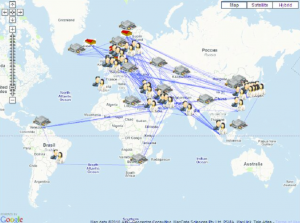
The hugely complex supply chains of the largest global commercial sector organisations are the focus of this task. As indicated in our previous blog[1] in this series, a comprehensive understanding of the origins of products and the movement of components, facilitated by location (geospatial) analytics, permits businesses to better anticipate and mitigate risks. Such analytical tools enable the identification of vulnerabilities stemming from physical disruptions, business continuity threats, and potential cost increases driven by climate-induced factors. Recently published research conducted by Economist Impact[2] reveals that over 99% of surveyed executives acknowledge that climate change has already affected their supply chains.
Implications for Investment Strategy
There is increasing recognition of the pressing need for better location intelligence to underpin investment decision-making. The London Stock Exchange Group, for instance, has provided valuable insights through its NetZero Atlas series[3], highlighting how investors and markets are responding to physical and climate risks, which, in turn, are reshaping asset valuations globally. Their analysis, heavily based on multiple sources of location data, for instance draw some “scary” conclusions on physical climate risks, including:
- Heatwaves: Over 327 million people globally will face extreme heat (>35°C for 30+ days/year) by 2050 – including Los Angeles, Houston, Shanghai, and Hong Kong – up from just under 10 million today.
- Flooding: in the UK, the Thames Estuary could face $100 billion in GDP at risk, with national exposure rising to 9.7% of GDP by 2050.
The insurance industry is striving to adapt to this new landscape where physical and business continuity risks are increasing in both frequency and magnitude[4]. The absence of adequate and appropriate insurance coverage can precipitate systemic failures. Witness, for instance, the Californian property sector, where rising premiums, some increasing by 50% or more, or even refusal to cover, have begun to depress property values[5]. As the insurance industry becomes more aware of the risks facing its clients, premiums are likely to increase. Organisations need to take the opportunity now to get “ahead of the curve” and assess their exposure to business continuity risks.
Location Intelligence – assuaging unmoderated AI concerns
Reliable geospatial analysis depends on high-quality data and robust metadata to ensure transparency and accountability. As artificial intelligence becomes increasingly prevalent in analytical processes[6], the need to maintain stringent data quality standards becomes increasingly critical. Carefully developed agentic AI systems, guided by geospatial experts, can significantly enhance our understanding of complex impacts and their ramifications whilst reducing the risk of drift, or even worse, hallucination[7].
Summary
We are only beginning to realise the potential of location intelligence in supporting more informed decisions that benefit people, the planet, and economic prosperity. It is anticipated that 2026 will witness the emergence of such capabilities as a critical component in addressing urgent global risks—a development that is both timely and necessary.
Leverage our independent expert knowledge
Our team have uniquely deep knowledge and insights, based on decades of international experience of location intelligence.
Talk to us: info@consultingwhere.com
[1] Geospatial-supply-chain-analysis-a-growing-opportunity
[2] Climate change’s disruptive impact on global supply chains and the urgent call for resilience
[3] https://www.lseg.com/en/insights/cop30-net-zero-atlas
[4] The Uninsurable Future: The Climate Threat to Property Insurance, and How to Stop It | Yale Law Journal
[5] What the California Wildfires Mean for Insurers and Homeowners – Knowledge at Wharton
[6] McKinsey report that in their 2025 survey 88% of respondent report regular AI use in at least one business function, compared with 78 percent a year ago. https://www.mckinsey.com/capabilities/quantumblack/our-insights/the-state-of-ai
[7] [2507.19586] Mitigating Geospatial Knowledge Hallucination in Large Language Models: Benchmarking and Dynamic Factuality Aligning